Drawing on the ministry of Jesus Christ to confront injustice and oppression & Engaging in mission and outreach.
I believe I have spoken to my strong sense of justice throughout each of the marks, and I come to ministry formed by my work for environmental justice and affirming the dignity of all of God’s creatures. I have helped start community gardens, designed social media campaigns about environmental racism, hosted campus-wide waste reduction programming like clothing swaps, and worked for greater food accessibility during the SNAP crisis.
When people hear that I am an environmentalist, they assume that it means that I care about saving nature, as some sort of abstract concept that is separate from humanity. It feels very important for me to stress that my faith does not just lead me to grow flowers and hug trees, (though I do those things too,) but to care deeply about the systemic racism, sexism, and classism that is manifest in how we treat the environment. Scripture tells us that the land, or adamah, bears witness to bloodshed and cries out at injustice (Gen 4:10-11). I consider it my ministry to invite people to listen.
I made the following posts for my work as the Social Media and Communications Coordinator for the Farminary. In these posts, I tried to make complex ideas like environmental racism accessible and understandable to a general audience. I condensed extensive research into just a few sentences, with the goal of making something that people would actually read and learn from. I hope to continue honing my communication skills for the mission of connecting people with their sense of place in creation, uplifting the witness of land, and working for environmental justice.
Practicing the radical hospitality of God.
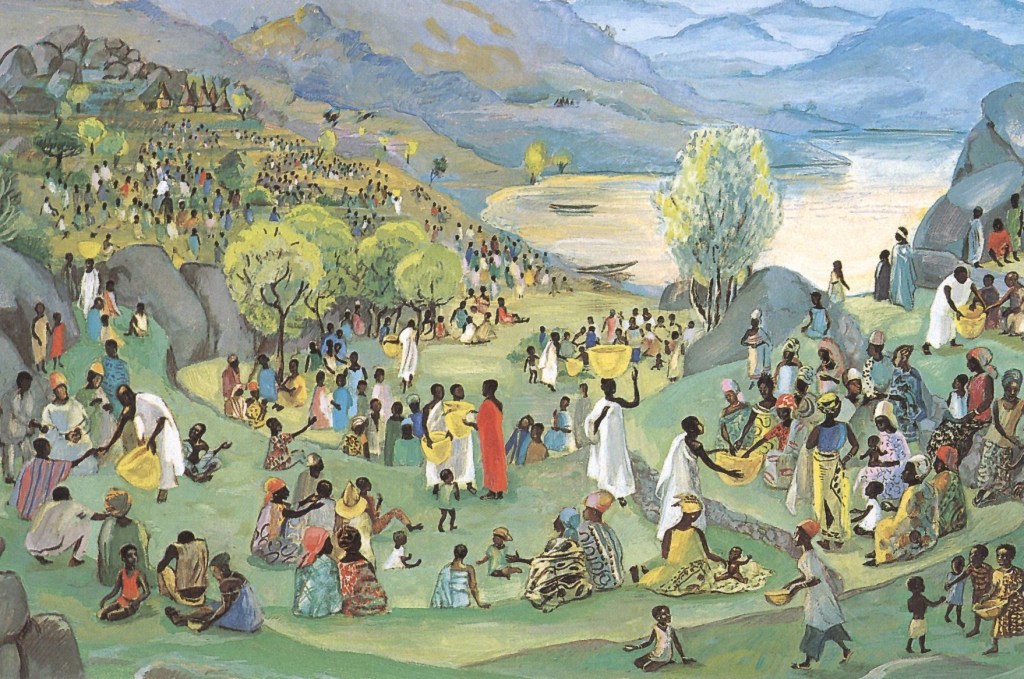
The very first sermon I wrote in seminary was on the Feeding of the Five Thousand in the Gospel of Matthew, which remains one of my favorite scripture passages to this day. The Feeding of the Five Thousand is a story about Jesus rejecting scarcity, affirming that there is more than enough to share, and inviting his disciples to do the same. Jesus invites the crowd, invites us, to share. To feed each other, to keep passing the basket round and round.
Today, we live in a world that produces more than enough food to feed the entire population, and where people go hungry because of the blatant greed of the wealthy and the siloing of resources. While my work can sometimes feel like a drop in the bucket, I believe I have a steady orientation towards hospitality, generosity, and food access. I have learned from my fellow farmers about local food networks and packed CSA shares to be distributed for free by mutual aid networks. I have learned from my work at Princeton Presbyterians about the difference a weekly dinner can make in a student’s life. I have hosted potlucks at the Farminary open to my entire seminary community, and been shocked at how many people we could feed by grilling flatbreads or making a giant salad together.
I love this painting of the Feeding of the Five Thousand, because it shows the crowd’s participation, shows that we all have a role to play in building God’s kindom on earth. If I had to pick one vision for my ministry, for the work of the church, it would look like this.
Identifying and working to overcome explicit and implicit bias in the life of the Church.
As someone who loves to study, teach, and preach the Hebrew Bible, I think a lot about what it means to share our sacred texts with another major religion. Our Christian history is sadly dominated by anti-Judaism, which still makes its way into our theology today. Some anti-Judaism is blatant, such as in certain sects of Christian Zionism, which treat Jewish and Palestinian bodies as disposable in their theology of the end times. The UCC has been vocal in its condemnation of Christian Zionism for many years, and I am proud to participate in the work of countering politically violent theology.
However, even in more progressive church spaces, anti-Judaism still shows up in how we read and exegete scripture. Even the most good-intentioned preachers still often use Judaism/Phariseeism as a foil to the ministry of Jesus, erasing Jesus’ Judaism in the process. For one of my classes, “Judaism in the New Testament,” I wrote an exegesis of the Wedding at Cana story in John, which you can read in the appendix, in which I addressed the harm of supersessionist readings of this story. I also recently had the opportunity to write about Jewish context and Judeophobia in scripture for a project called “How to Read the Bible,” an accessible and thoughtful guide created by my friends Amanda Samuel and Sofia Na. You can read my contributions and the full guide (which I highly recommend) here. In short, I think we need to do the hard work of reading scripture within its Jewish context, while acknowledging that we are non-Jewish readers inheriting generations of anti-Jewish theology and bias. This is the work I am committed to in my ministry.
In my current church context, I am leading a six-session group called “Nonviolence and Peacemaking: An MLK Study Group.” Throughout this course, we are engaging with Dr. Martin Luther King’s theology of nonviolent social change, as well as related thinkers including Diane Nash, Walter Wink, and Fannie Lou Hamer. This course seeks to bring us into the deep (and sometimes difficult) work of loving the other. We are asking questions such as who “counts” as a neighbor, how do we love our enemies without foregoing accountability, and what does it mean to live together as a beloved community. You can read my full curriculum in the appendix.
Understanding community context and navigating change with a community Building relationships of mutual trust and interdependence.
Being a church means loving each other even when it’s hard. When conflict arises, as is normal in any community, I work to listen empathetically to the perspectives of others and to stay attentive to power dynamics, so that everyone has a voice at the table. While working at one of my field education internships, I witnessed a challenging church council meeting where individuals expressed discomfort with the church flying the pride flag, and I noticed that the only queer council member stayed silent. Afterwards, I checked in with that individual, and we began to navigate her feelings of hurt and the pressure she felt to “just let it go.” We brainstormed ways for her to communicate her needs without taking on the full burden of reconciliation, and she was able to express openly with other members of the council. While I was a very small part of a larger journey, I saw the church become a little safer and a little more open in my year there.
Conflict is hard, but I think it’s easier when we trust each other enough to be open and honest. I care a lot about building relationships, and commit myself to the work required to create mutual trust. I plan to continue this work in my pastoral residency, and look forward to spending longer and more intensive time in a church setting where I can see the congregation change and grow. I am especially looking forward to seeing what arises in our nonviolence group, where we will be explicitly discussing conflict management and loving our enemies.
Building relationships of mutual trust and interdependence.
As an extroverted, social person, I have to be most attentive to my needs for interpersonal connection and how they might affect my work. I work to create meaningful relationships with congregants, but also prioritize having a social life outside of work, so that I avoid dual relationships. I am very lucky to have really amazing friends from childhood, college, and seminary. I pour a lot of love and energy into these relationships, and they sustain me in return.