
Exhibiting knowledge, understanding, and continuing study of the Hebrew Scriptures and the New Testament.
My academic background and proficiency in scriptural exegesis is one of my stronger marks as I enter my career in ministry. I have studied scripture in both the undergraduate and graduate setting, and studied both Greek and Hebrew in seminary. I have a special love for Hebrew exegesis; I took Biblical Hebrew for four semesters and loved tutoring the introductory class. Studying and reading scripture has been one of my favorite parts of my academic life, and I am excited to continue to integrate my studies with my work in the church. It is extremely important to me that the issues we talk about in seminary not be gatekept to the ivory tower, and I aim to bring my Biblical studies to people’s lived experience through my preaching and adult education classes. As I enter my pastoral residency, one of my ministries will be leading a weekly Bible study, where I can continue studying scripture in community while learning to make my seminary lessons accessible and engaging.
My amazing Bible classes!
Undergraduate:
- Introduction to Biblical Studies
- New Testament Study of the Gospels
- Disability in the Jewish Bible
- Feminist Theology
- Gender in the Jewish Bible
Graduate:
- Introduction to Biblical Hebrew
- Introduction to Biblical Greek
- Exegesis of Song of Songs
- Exegesis of Ecclesiastes
- Jews and Judaism in the New Testament
- Sex and Gender in the Old Testament
I am especially interested in feminist, ecological, and disability hermeneutics. You can read two of my favorite exegesis papers in the appendix.

Maturing in effective proclamation and preaching & Bringing life to sacred stories and traditions in worship, proclamation, and witness.
Over the past three years, I have worked to mature and gain confidence as a preacher. As I mentioned above, I love Biblical exegesis. I am a big nerd and have thrived in the academic setting. And yet, all my academic work feels meaningless if I can not bring meaning to people’s lives and be a small part of our collective liberation.
I preached twice for my internship at Upper Dublin Lutheran Church, preached several times during my hospital internship, preached three times for my internship with Princetion Presbyterians, and have guest preached at several congregations. I have cultivated my preaching through “Introduction to Preaching” and “Preaching Death, Dying, and Eschatology with the Earth” with preaching professor and eco-trauma expert Dr. Wagner. After my second year of seminary, I was awarded the Edward Howell Roberts Scholarship in Preaching. Upon graduation, I was awarded the Jagow Award in Homiletics & Speech.
I consider it an incredible privilege to engage in the act of proclamation, and I still have so much to learn! I am looking forward to preaching on a regular basis through my pastoral fellowship and receiving feedback and mentorship from experienced and talented preachers.
You can watch me preach or read my sermon series in the appendix.
Understanding the history of the Christian Church, from biblical times forward
It would be incredibly presumptuous to say that I understand the entire history of the Christian Church. A lot happened between biblical times and now! I will instead make the more modest claim that I love to learn, and have been lucky to take excellent courses that have broadened my perspective both of church history and the world church. Through my two World Christian History courses, I got a broad overview of content from the early church to the Reformation to the colonial and post-colonial global church. Through my UCC History and Polity class, I got to deepen my understanding of the origins of the UCC, especially by learning about each of the five streams that make up the one church.
One special experience that shifted my understanding of the “center” of Christianity was a travel course to Brazil that I was able to take through Princeton Seminary. In Brazil, I learned about the complicated and often fraught history of religious syncretism, experienced an inculturated Catholic mass, and met living figures making history such as theologian Ivone Gebara and activist Father Júlio Lancellotti. I left Brazil with a clearer idea of what religion can bring to society, particularly a society with a rapidly growing far-right movement fueled by isolation and fear. It was an incredible experience, and taught me that religious history most often is made in what we may consider the margins.
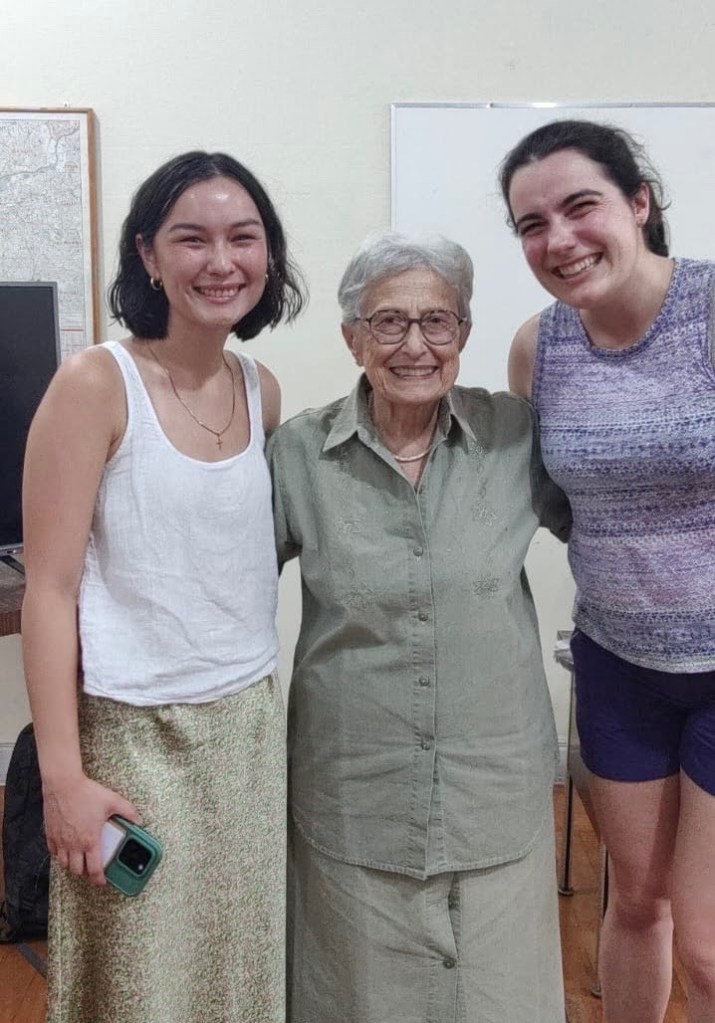
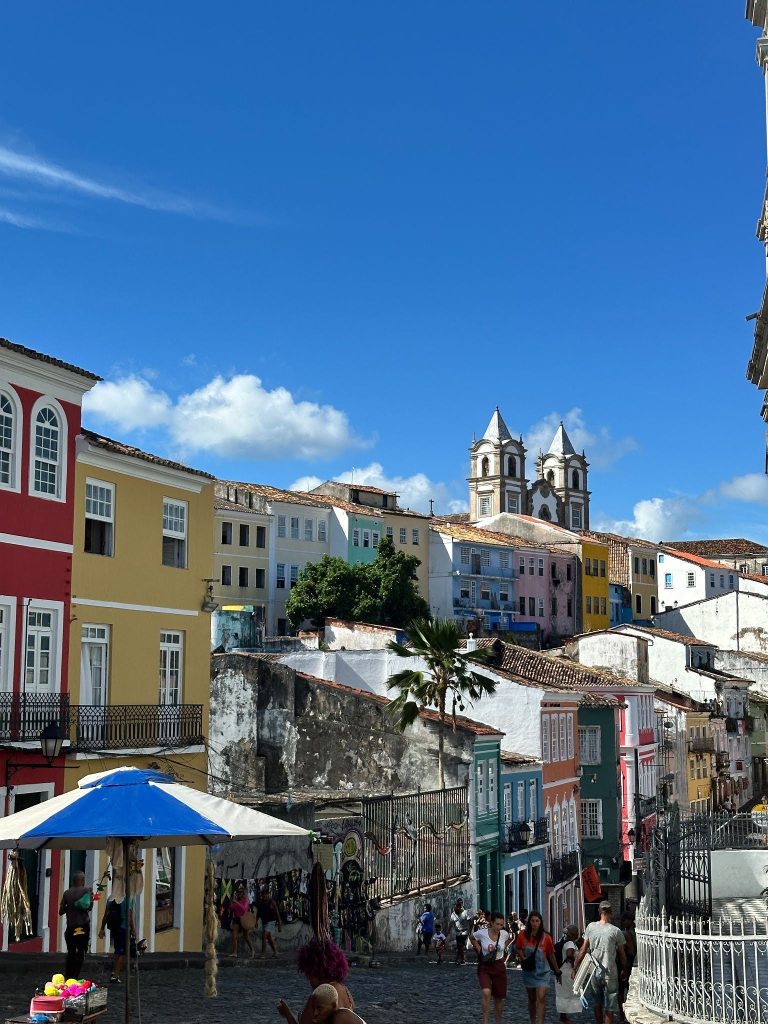
Me and my friend Jessi with Ivone Gebara/Historic Centre of Salvador de Bahia
Leading faith formation effectively across generations.
Through my seminary internships, I have gotten experience meeting people wherever they are at in their religious journeys, and I feel so grateful for the people of all ages I have met in the church, university, and hospital. I have gotten to lead children in Godly Play, cultivate spaces for queer university students, and mediate end of life conversations in hospital rooms.
One growing edge that I’ve gotten to work on is my children’s sermons. At first, I had trouble coming up with accessible and engaging messages for the children of various ages at Upper Dublin Lutheran Church. After feedback and consultation with my wonderful mentor, the faith and family director of the church, I was able to adapt my approach and participate in children’s ministry with more joy and connectivity. I am looking forward to continuing to develop my faith formation skills through my residency at Village Church, which has a robust children and youth program and lots of opportunities for mentorship and growth.
Holding the Holy with integrity especially as represented in the Sacraments.
One of the most important ways I experience the divine in community is through the sacrament of communion. I grew up in a church that celebrates communion every week. This past year, I helped lead a service called “Breaking Bread” through my internship at Princetion Presbyterians where we celebrate communion every week (with delicious homemade bread). Some of the moments that felt the most significant to me throughout my internship were holding the bread or the cup and serving my community. There is something so tender, so lovely, to me about the act of feeding each other, and that specialness is multiplied in the holy act of communion, which was taught to us by Jesus Christ.
There is a stereotype that communion is not as important in Protestantism, especially within the Reformed traditions, because it is “just a symbol.” But symbols and rituals are how we construct meaning, and how we communicate what we believe about God, which makes them incredibly powerful. The act of breaking bread and sharing grape juice or wine together proclaims that God’s love, and the community of the church as ordained by the Spirit, is for everyone. Christ’s life, death, and resurrection was and continue to be for everyone.
Further, I believe the open table symbolizes and enacts our Christian commitment to feeding everyone. To summarize my theology of sacrament, I like to pull from Isaiah 58:6-7:
“Is not this the fast that I choose:
to loose the bonds of injustice,
to undo the straps of the yoke,
to let the oppressed go free,
and to break every yoke?
Is it not to share your bread with the hungry
and bring the homeless poor into your house;
when you see the naked, to cover them
and not to hide yourself from your own kin?”
I think it matters that our sacraments are not just about personal transformation, but communal justice. We use our bodies to enact the world we are building— one where everyone has a seat at the table. One where no one goes hungry. One where there is more than enough for everyone.

